Sunday, 18 March 2012

Yes, BlackBerry 10 Is Headed to the PlayBook … Someday


BlackBerry 10, the latest version of
 Research
 In Motion’s mobile operating system, isn’t 
intended for the company’s handsets alone.
 It’s destined for the PlayBook tablet as well.
Rob Orr, RIM’s vice president of product management, tells TechRadar that the company will debut a BlackBerry 10-based handset “toward the end of 2012,” and will follow it by bringing “BlackBerry 10 to our PlayBooks.”
Reached for comment, a RIM spokesperson confirmed Orr’s remark: “BlackBerry 10 is being designed for our next generation smartphones, as well as for the BlackBerry PlayBook. Owners of BlackBerry PlayBook today will be able to update their tablet to the BlackBerry 10 OS via a free software update once the tablet software version is available.”
That’s the plan, anyway. And it makes perfect sense, since BB10 is based on the same QNX platform as the current PlayBook OS. The only problem here is the one that’s plagued RIM for months now: The timeline.
The company has repeatedly delayed the launch of BlackBerry 10 and the next-generation devices based on it, while continuing to promote the hell out of it. And the further it pushes them out, the longer it has to rely on its current operating system, which is pretty dusty at this point. And the longer it does that, the harder it is to retain the attention of consumers and developers, both of whom have plenty of other options when it comes to smartphones.

Satisfaction, Thy Name Is iPhone


Here’s a data point sure to get prominent mention
 during Apple’s next big media event. The iPhone has
 once again claimed the top ranking in J.D. Power’s
For the seventh consecutive time.
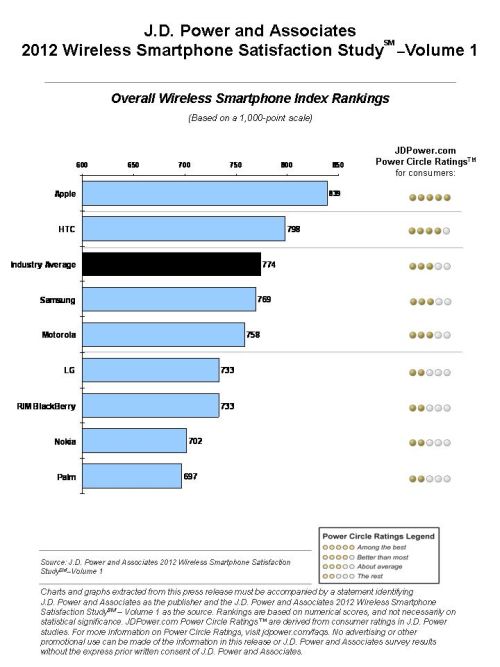
The iPhone scored 839 out of 1,000 possible points. That’s a point more than it claimed in J.D. Power’s September 2011 survey, and 41 points more than its nearest rival, HTC, which scored 798 (down from 801).
It’s also 64 points more than the industry average of 774, beneath which rivals Samsung, Motorola, LG, Research In Motion and Nokia continue to toil. All five of those companies’ smartphones fell in customer esteem, some precipitously. Motorola’s score slipped to 758, down from 775; Samsung’s to 769 from 777; LG’s to 733 from 760; RIM’s to 733 from 762; and Nokia’s to 702 from 721.
What a sad commentary on the industry that smartphones from five of its seven largest vendors posted below-average scores in customer satisfaction.
Declining scores.
Ease of operation, operating system, physical design and the all-important battery performance — which, according to J.D. Power’s study, consumers identified as the least satisfying aspect of smartphones, by far — are features you’d think the smartphone industry would have pretty much dialed in by now. But evidently there’s still lots of room for improvement.

How Much Is Apple Worth?


Apple is a juggernaut. Its stock touched $600 on Thursday, which represents $560 billion in market capitalization. Compare this to Exxon Mobil, with a market cap of $400 billion, IBM’s $240 billion and Wal-Mart’s $210 billion. Can Apple really be worth that much?
The easy answer is that the company is worth whatever the market says it’s worth. Well, yes, the market is right every day — but it is right only for that day. What about tomorrow?

Google Apps VP Dave Girouard Leaving to Start a Company


Dave Girouard, who is Google’s VP of apps, is leaving
 the company, Google said today.
Girouard had been responsible for Gmail, Google Calendar
, Google Docs and other cloud applications.
After eight years at Google, Girouard plans to start his own 
company, though not in the enterprise space. Google Ventures will be investing in his start-up, alongside Kleiner Perkins and NEA.
(Update: Girouard’s new company is called Upstart, with the tagline “The Startup is You.” According to a splash page, “Upstart lets you raise capital in return for a small portion of your future income.”)
Meanwhile, back at the Goog, Girouard’s responsibilities will transfer to Sundar Pichai, leader of the Chrome and apps team. Pichai is one of Google CEO Larry Page’s septumvirate of product heads, who were established when he took over the company last April. Part of Pichai’s agenda has been to lessen the divide between enterprise apps and consumer apps.
Departures by long-time Googlers are surprisingly rare. Google’s first employee, Craig Silverstein, left to join Khan Academy last month.

Titre dHow to Signal That You Have an iPad 3 (Comic)u message


New iPad a Hotspot Now for Verizon, Not So Much With AT&T


So we jumped the gun a bit when we said that the new iPad can act as a hotspot for both Verizon and AT&T.
As our now-corrected story notes, the hotspot feature is ready now for Verizon. AT&T, meanwhile, says it is working with Apple on the feature. However, it won’t be ready for those buying or getting their iPads today, nor is there an ETA for when it will be available.
The hotspot capability lets the iPad serve as an Internet connection for a laptop or other Wi-Fi device.
It’s not immediately clear what the holdup is, as Verizon is offering the feature, and AT&T already offers a hotspot option on its iPhone lineup.
An Apple representative said that the company has turned on the feature at the hardware level, and that it is available to any carrier that wants to offer it.
Meanwhile, a couple of other notes on the iPad models with built-in cellular connectivity.
As a reminder, the iPads in both the AT&T and Verizon options will run on high-speed LTE networks, where available. However, because AT&T and Verizon use different frequency bands, buyers have to decide at the time of purchase which one they want.
Beyond North America, Apple isn’t supporting LTE, but is supporting faster flavors of the HSPA network that are being adopted faster than LTE abroad. Models purchased abroad will support LTE on AT&T’s network, while both Verizon and AT&T iPads bought in the U.S. will be able to roam internationally on 3G.
Apple isn’t making a version of the new iPad that works on networks from either Sprint or T-Mobile USA.
Of course, chances are that none of this was on the minds of the happy folks who lined up this morning for the first units, like this crowd in New York City:

Apple’s New iPad Costs at Least $316 to Build, IHS iSuppli Teardown Shows


Apple’s new iPad hit store shelves today.
 That means that along with the lines at the
stores and the requisite applause of store
 employees cheering people who buy them, 
there were among the many iPad buyers today
 people who just couldn’t wait to get the gadget
 torn apart.
The analysts at the market research firm IHS iSuppli, considered by the investment community to be the most reliable of the organizations that conduct teardowns, were among that set. Today, somewhere in Southern California, an iSuppli analyst stood in line at a store and promptly took an iPad to a lab, where it was torn into, initiating the interesting process of estimating what it all cost to build.
Here’s what iSuppli’s team found: First off, there weren’t many changes from the last iPad, in terms of suppliers. “It’s most of the same characters we saw last time around,” analyst Andrew Rassweiler told me today. Wireless chipmakers Qualcomm and Broadcom both reappeared — Qualcomm supplying a baseband processor chip, Broadcom a Bluetooth and Wi-Fi chip, TriQuint Semiconductor suppling some additional wireless parts. STMicroelectronics once again retained its position supplying the gyroscope. Cirrus Logic supplied an audio codec chip.
The 16 gigabyte, Wi-Fi-only iPad that sells for $499 costs about $316 to make, or about 63 percent of the device’s retail price. On the upper end, the 4G-ready 64GB model that sells for $829 costs about $409 to make, or about 49 percent of the retail price.
The new cost figures represent an increase of between 21 percent and 25 percent, depending on the model, from the iPad 2, which iSuppli tore down last year.
So what did they find inside? An expensive Samsung display, for one thing. All thosemillions of pixels don’t come cheap. ISuppli analyst Andrew Rassweiler estimates that the display, which cost $57 on the iPad 2, has grown in cost to $87 on the latest iPad.
Rassweiler says that two other vendors, LG Display and Sharp Electronics, have inked display supply deals with Apple for the latest iPad, but only Samsung is thought to have fully ramped up production. Depending on the vendor, the display may cost as much as $90, he said.
One set of components remained essentially the same as before: Those that drive the touchscreen capabilities. Rassweiler says that three Taiwanese companies, TPK, Wintek and Chi Mei, supply parts related to driving the central interface feature of the new iPad, but he says to expect a major shift in how Apple handles the touch interface on future iPads.
The combined cost of cameras, including the front-facing and back camera, is pegged at $12.35, more than three times the cost of cameras found on the iPad 2, Rassweiler says. But it’s essentially the same setup as that on the iPhone 4, he says. As has been the case with cameras, the identity of the supplier wasn’t easy to determine because they try hard to hide identifying information from the prying eyes of teardown analysts. The candidates, however, include Largan Precision Co., a Taiwanese supplier of camera modules to wireless phone companies, and Omnivision. On the iPhone 4S, a research firm called Chipworks identified the supplier of the CMOS sensor in one of the cameras as having come from Sony.
As with other Apple devices, the main processor chip is an Apple-made A5X processor, one manufactured under contract by Samsung. The estimated cost of that chip is $23, up from $14 on the iPad 2.
Another part that’s more expensive than on the last iPad, but also better for a variety of reasons, is the battery. This one is estimated to have cost Apple $32, up from $25 on the iPad 2. But it constitutes a significant upgrade, Rassweiler says, with 70 percent more capacity than before. Apple benefited in part by lower prices in the lithium polymer material used to make the battery, offsetting the cost of adding a vastly improved battery.
ISuppli wasn’t the only outfit conducting teardowns of the iPad today. An enthusiast site called iFixit that encourages consumers to learn how to repair and upgrade their own electronics, flew technicians to Australia to conduct its own teardown analysis.
No New Xbox “Anytime Soon,” Says Microsoft


icrosoft’s Xbox 360 is selling so well there’s
 no need for the company to release its
 successor this year.
The company confirmed today that it won’t be
 unveiling a new Xbox console at the E3 video 
 probably shouldn’t expect new hardware for game conference in June, and said consumers
 quite a while.
“While we appreciate all the interest in our long-range plans for the future, we can confirm that there will be no talk of new Xbox hardware at E3 or anytime soon,” Microsoft’s Corporate Communications boss Frank Shaw told AllThingsD. “For us, 2012 is all about Xbox 360.”
And for good reason. Shaw notes that the past year has been the best ever for Xbox 360 — a year in which it outsold not just all other gaming consoles, but DVD players and digital media receivers as well.
With demand for the Xbox 360 that robust, Microsoft can take its time bringing a successor to market, milking another year of strong sales out of the 360, which is still riding an upswell of momentum thanks to its Kinect motion-sensor peripheral and a strong lineup of games.

Great App-pectations: When Innovation Leapfrogs Phone Capabilities


As comic Louis C.K. would say about technology: Everything is amazing and nobody is happy.
Nowhere is that more true than in the world of smartphone applications, as app developers push the possibilities of how to use our smartphones’ location awareness and reach well beyond what our mobile data plans and battery lives seem to be able to support, especially in densely populated spaces.
It’s kind of sad, because for a while the release of new devices has set off rushes of creativity, with developers using touchscreens and accelerometers and other sensors in ways that seemed to make science fiction real.
With every available power outlet in use, a popular FedEx promotion brought a "human charging station" to the street. Thankfully it didn't enlist homeless people.
We see great stuff like phone cameras being used for everything from detecting heart rates totranslating paper menus from one language to another. We watch serendipitous location-sharing tools go from typing in an address five years ago (Dodgeball), to linking with a crowdsourced database three years ago (Foursquare), to ambient awareness this year (Highlight).
The disconnect between app dreams and phone reality was particularly evident at the South by Southwest Interactive conference in Austin this past week, where official attendance hit nearly 25,000, up 27 percent from last year. Combined with everyone else in the hip Texas town, including many SXSW partiers without passes, that made for phone network overload.
And when our phones are constantly searching for a signal or tracking our locations, their battery life tends to suck. Literally.
As most did, I had a hard time getting mobile data during all five days I was in Austin, with ongoing weak 3G service on my iPhone 4 on the AT&T network. AT&T wouldn’t give me a comment on its SXSW performance beyond a map of its event service plan, including 220 Wi-Fi hotspots and a couple of “COW” (cellular on wheels) trucks.
Other outlets also reported that bad data access at SXSW 2012 was a problem for many people. (Although not everyone and not every device had issues: Walt Mossberg waspulling down 18 Mbps back in his hotel room on his new Verizon LTE iPad that he was testing.)
Here’s the problem: SXSW has become a place where app developers come in the hopes that they can persuade a dense, social audience of early adopters to try their shiny new way to find what’s going on and where. Hundreds of start-ups lust after the idea of “winning SXSW,” following past examples of Twitter and Foursquare, and, to a lesser extent, GroupMe.
There was much debate, egged on by tech bloggers, about who would be crowned the SXSW winner this year. I think the consensus was that nobody won, although Mophie battery packs for the iPhone and sponsors who brought charging stations should get an honorable mention.
But I’d argue that one of the reasons it was impossible to “win” in 2012 was that these location and communication apps were hindered by poor service and battery life impact.

Also, as aged as they are in comparison to the newborn location vampires, Foursquare and Twitter still dominate SXSW. There were 755,373 total tweets with the keyword or hashtag “SXSW” during the Interactive portion of the festival, according to PeopleBrowsr. At one point, I had the 3,702nd concurrent Foursquare check-in at the Austin Convention Center.
“Foursquare’s part of the fabric of SXSW,” said Foursquare CEO Dennis Crowley in an onstage interview at the event. I think he’s right.
But then Crowley took it a step further: “Foursquare in Austin at SXSW is like Foursquare of the future. It’s going to be everywhere.”
If that’s the case — and I’m not sure it is — I don’t think the future sounds so great. Because using Foursquare at SXSW was actually a total chafe. It often took four tries to send my Foursquare check-ins to the server. The error messages were constant.
More daring apps like the new Highlight — which constantly tracks users and pings them when they are near people with common friends and interests — had even more problems. One morning when I loaded up Highlight, the app told me that I had been in close proximity to 10 people the night before between 1 am and 2:30 am, over on the other side of the river from where I was staying.
Boring as I am, I was home in bed by then.
When I asked Highlight co-founder Paul Davison why the app messed up, he said Highlight had been experimenting with using mobile cell towers to locate users, because GPS has such an impact on their batteries. The cell tower had apparently retained my location while I was sleeping across town, not having opened the app and sent it an updated location.
(Although, to be honest, I don’t really want to share where I am while I’m sleeping — which is a very different concern.)
Thus, I found that a good SXSW icebreaker question was: “So, have you uninstalled Highlight yet?” In an unscientific but anecdotally significant number of cases, the answer was yes. Why? Almost always: Battery drain.
Davison said Highlight — which only launched in January — is working to improve accuracy and decrease battery impact. He added that he’s hopeful people will overlook these issues.
“For many, the ability to see profiles of the people standing nearby is so new and exciting that they want to try it out now, even if the location precision and battery life is not yet where they’d want it to be,” Davison said.
Foursquare’s response was similarly optimistic. As far as service goes, “things have gotten much better [at SXSW] in the last couple of years and are continuing to improve,” said a spokeswoman. “And battery life should be much better next year with the iPhone 5, iPad HD and new Android handsets launching.”
Everything might be exciting, but if your phone’s dead, you’re not using it. That makes me and many others unhappy.
Because while I’m sure better and more expensive services and devices will be on the market next year, I’m also sure SXSW 2013 will be even more jam-packed.

Google Confirms Kevin Rose and Some of Milk Team Will Join


Google  confirmed the news we brought you yesterday: Kevin Rose and some of the team from his mobile app incubator Milk will be joining the company.
The word came in two Google+ posts by Bradley Horowitz and Kevin Rose, which speaks to our assumption that Rose will be working on Google’s social team. “I can’t wait to be a part of the amazing team that is shaping the future of the web,” Rose wrote today.
Those joining the company are Rose, noted designer Daniel Burka, biz dev guy Chris Hutchins and designer Joshua Lane. We’d reported yesterday that each of the employees will be receiving on the order of $1 million to $2 million, and investors are getting their money back, plus a little extra.